


 Open Access
Editor-in-Chief

University of Chile, Chile
eISSN
3029-2646
Publication Frequency
Semi-annual
Indexing
CAS
Google Scholar
J-Gate
All the publications will be archived by the PKP Preservation Network for long-term electronic preservation.
Authors are encouraged to self-archive the final version of their published articles into institutional repositories (such as those listed in the Directory of Open Access Repositories).
Authors are also encouraged to use the final PDF version published on the website of Academic Publishing.
About the Publisher
Academic Publishing insists on taking academic exchange and publication as the main line, carrying out comprehensive management based on science and technology, and fully exploring excellent international publishing resources. Within 5 years, it will form a strategic framework and scale with science (S), technology (T), medicine (M), education (E), and humanities and arts (H) as the main publishing fields. Academic Publishing is headquartered in Singapore and based in Malaysia, with the United States and China providing the main scientific and academic resources. At the same time, it has established long-term good cooperative relations with other publishing companies, scientific research communities, and academic organizations in more than a dozen countries and regions. Academic Publishing uses English and Chinese as its main publishing languages, mainly publishing books, journals, and conference papers in print and online. The vast majority of publications follow the international open access policy, providing stable and long-term quality and professional publications. With the joint efforts of the expert team and our professional editorial team, our publications will gradually be indexed by international databases in stages to provide convenient and professional retrieval for various scholars. At the same time, manuscripts we accept will be subject to the peer review principle, and cutting-edge and innovative research articles will be preferentially accepted for peer reference and discussion. All kinds of our publications are welcome for peer to contribute, access, and download.
Volume Arrangement
2023
Featured Articles
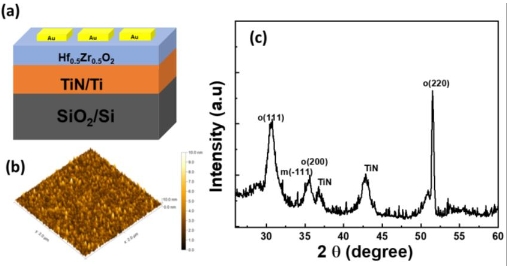
In this study, Zr-doped HfO2 (HZO) based resistive random-access memory (RRAM) device were fabricated. The Hf:Zr (1:1) ratio in the HZO films were controlled by changing the HfO2 and ZrO2 cycle ratio during the atomic layer deposition (ALD) process. Next, we studied the structural and electrical properties of the Au/HZO/TiN RRAM device structure. The RRAM devices exhibits an excellent resistance ratio of the high resistance state (HRS) to the low resistance state (LRS) of ~10 3 A, and as well as good endurance (300 cycles) and retention (>10 3 s), respectively. Further, the device showed different conduction mechanism in LRS and HRS modes. The lower biased linear region is dominated by ohmic conductivity, whereas the higher biased nonlinear region is dominated by a space charge limited current conduction. This device is suitable for application in future high-density nonvolatile memory RRAM devices.
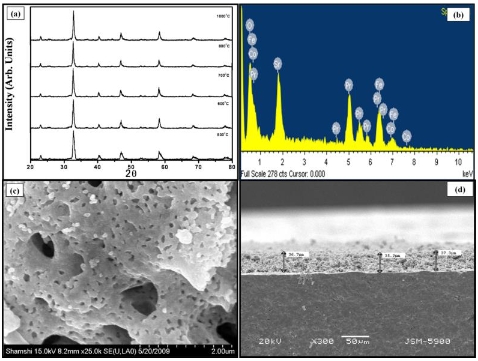
Solid oxide fuel cells (SOFCs) are renowned for being effective energy sources that have potential to influence how energy is developed in future. SOFCs operate at low temperatures provides different benefits for widespread commercialization. In the present study a perovskite material Pr0.6 Sr0.4 Fe0.8Co0.2 O3−δ (PSFCo) was investigated as cathode for SOFC in intermediate temperature range. Glycine nitrate process was used for the preparation of the samples. PSFCo exhibited cubic structure having small particle size (100–200 nm). The electrical conductivity of the PSFCo was measured as function of temperature up to 850 ℃. The sample displayed maximum electrical conductivity of 370 Scm −1 at around 550–600 ℃. The polarization behavior of PSFCo was calculated by means of AC impedance with Sm 0.8 Ce 0.2 O 2 (SDC) as electrolyte. The value of area specific resistance (ASR) was calculated as 0.146 Ωcm 2 at 800 ℃ and 0.248 Ωcm 2 at 700 ℃.
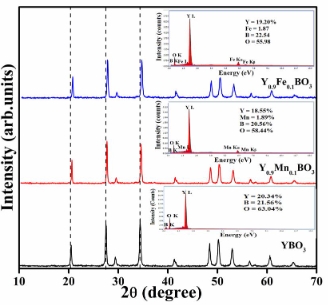
Manganese and iron-doped π -YBO3 have been synthesized using a modified epoxide-mediated gel method. The PXRD pattern evaluated the formation of the desired phase and the structural changes. EDS spectra determined the elemental analysis of undoped and doped samples. Raman spectra observed the stretching and bending modes of B-O bonds. The direct band gaps for doped samples were 1.47 and 2.07 eV, respectively, lower than the band gap value of 5.81 eV for π -YBO3 . The green and blue indigo emission bands were observed in the photoluminescence spectra. Doped samples showed good magnetic properties as they are antiferromagnetic and ferromagnetic at low temperature (T = 5 K) M-H plot and SQUID measurement. An indigenously built Sawyer-Tower circuit is used to measure ferroelectric hysteresis. Photodegradation studies of RhB were conducted under UV-visible irradiation.

This study compared gas-metal arc welding (GMAW) and laser beam welding (LBW) for the superposed joining of two low-carbon steels. The motivation was to reduce the visible defects (notches) in the external part of one of the sheets. Both welding processes produced sound welds characterized by ferrite and pearlite; however, the notch disappeared when LBW was used. The hardness values of the fusion and heat-affected zones were similar for both processes, but the tensile strengths were very different. The shear tensile strengths of the LBW and GMAW were 415 and 84 MPa, respectively. Finite element analysis simulations indicated a more diffuse distribution of the von Mises stress throughout the welded component. The GMAW FEA model also presented a defect because of excessive heat transfer and residual stresses. In conclusion, LBW can replace GMAW in this particular case with improvements in appearance, productivity, and mechanical strength.
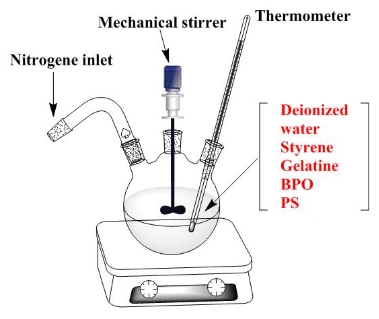
In this study, Buxus sempervirens leaf ingredient (LP) and the carbon (LC) and the ash (LA) were obtained, which are the bio-originated materials. Carbon and ash obtained from this natural plant were prepared by heating and pyrolysis for 2 h at 250 ℃ and 700 ℃, respectively. Then, the solution casting method was used to prepare the composites of these bio-additives with polystyrene. Next, the effects of the additives on diffuse reflectance spectroscopy (DRS) and X-ray diffraction (XRD) spectra of polystyrene were investigated. In addition, the additives led to noticeable changes in X-ray diffraction results, implying a change in the morphology of the polymer. All of these observations imply the uniform formation of the polystyrene (PS) composites with the micro and bio-fillers.