

Large-scale transferability of a PSO-optimized hybrid energy system: A comparative study of two African regions
-
Souleymane Kientega

Research Team in Power and Control, Mohammadia’s School of Engineering, Mohammed V University in Rabat, Rabat P.B. 765, Morocco
-
Mohammed Ferfra
Research Team in Power and Control, Mohammadia’s School of Engineering, Mohammed V University in Rabat, Rabat P.B. 765, Morocco
-
Youssef El Baqqal
Research Team in Power and Control, Mohammadia’s School of Engineering, Mohammed V University in Rabat, Rabat P.B. 765, Morocco
Abstract
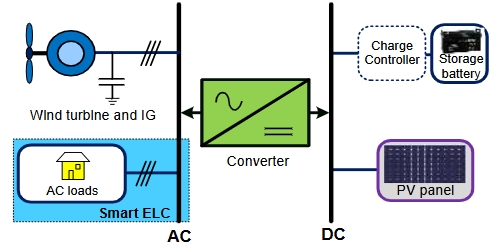
This study looks at the resilience and cross-region fidelity of a HRES (Hybrid Renewable Energy Systems) across multiple climates in Africa. The study modelled the systems with a PSO (Particle Swarm Optimization) algorithm in MATLAB (Matrix Laboratory). “Large-scale transferability” refers to the system’s capacity maintained against tight acceptance criteria. Normalized load curves were used to derive the climate impacts and case studies were in Laâyoune–Sakia El Hamra, Morocco and Ouagadougou, Burkina Faso. They display high adaptability of the systems; a complementarity of winds and solar see a LCOE (Levelized Cost of Energy) of 0.0954 USD/kWh and an annual system cost of $100,039 in Laâyoune–Sakia El Hamra, in Ouagadougou dominates mostly solar, with additional storage requirements, remained very competitive, with LCOE at 0.1014 USD/kWh (+6.3% variance). Both sites achieved similar levels of reliability (Loss of Load Probability, LLP ≈ 0.01) and reduced CO2 emissions significantly (275.29 tCO2/yr and 283.13 tCO2/yr, respectively). LCOE variation was less than 6.5% and LLP variation is less than 0.002, regardless of climate change. These results demonstrate that the flexibility of the methodology employed ensures the maintenance of techno-economic advantages, even in the face of a 45% decrease in wind power potential. Thus, the present paper contributes to the further evolution of HRES design—from an ad hoc narrow-site-specific optimization regime to a scalable, context-sensitive design framework. It also proposes a proven path toward sustainable and affordable renewable energy growth in developing countries.
Copyright (c) 2026 Souleymane Kientega, Mohammed Ferfra , Youssef El Baqqal

This work is licensed under a Creative Commons Attribution 4.0 International License.
References
[1]Nyarko K, Whale J, Urmee T. Drivers and challenges of off-grid renewable energy-based projects in West Africa: A review. Heliyon. 2023; 9(6): e16710. doi: 10.1016/j.heliyon.2023.e16710
[2]Ebrahimi A, Ghorbani B, Taghavi M. Novel integrated structure consisting of CO2 capture cycle, heat pump unit, Kalina power, and ejector refrigeration systems for liquid CO2 storage using renewable energies. Energy Science & Engineering. 2022; 10(8): 3167–3188. doi: 10.1002/ese3.1211
[3]Soonmin H, Taghavi M. Solar Energy Development: Study Cases in Iran and Malaysia. International Journal of Engineering Trends and Technology. 2022; 70(8): 408–422. doi: 10.14445/22315381/IJETT-V70I8P242
[4]Afrouzy ZA, Taghavi M. Thermo-economic analysis of a novel integrated structure for liquefied natural gas production using photovoltaic panels. Journal of Thermal Analysis and Calorimetry. 2021; 145(3): 1509–1536. doi: 10.1007/s10973-021-10769-4
[5]Taghavi M, Lee CJ. Development of a novel hydrogen liquefaction structure based on liquefied natural gas regasification operations and solid oxide fuel cell: Exergy and economic analyses. Fuel. 2025; 384: 133826. doi: 10.1016/j.fuel.2024.133826
[6]Taghavi M, Lee CJ. Development of novel hydrogen liquefaction structures based on waste heat recovery in diffusion-absorption refrigeration and power generation units. Energy Conversion and Management. 2024; 302: 118056. doi: 10.1016/j.enconman.2023.118056
[7]Mquqwana MA, Krishnamurthy S. Particle Swarm Optimization for an Optimal Hybrid Renewable Energy Microgrid System under Uncertainty. Energies. 2024; 17(2): 422. doi: 10.3390/en17020422
[8]Mehallou A, M’hamdi B, Amari A, et al. Optimal multiobjective design of an autonomous hybrid renewable energy system in the Adrar Region, Algeria. Scientific Reports. 2025; 15(1): 4173. doi: 10.1038/s41598-025-88438-x
[9]Znati I, Ferfra M, Bouaddi A, et al. TID Controller for Load Frequency Control in Multi-Area Interconnected Systems with High Renewable Energy Penetration Using an Improved Grey Wolf Algorithm. In: Proceedings of the 2025 5th International Conference on Innovative Research in Applied Science, Engineering and Technology (IRASET); 15 May 2025; Fez, Morocco. pp. 1–8. doi: 10.1109/IRASET64571.2025.11008173
[10]Mulenga E, Kabanshi A, Mupeta H, et al. Techno-economic analysis of off-grid PV-Diesel power generation system for rural electrification: A case study of Chilubi district in Zambia. Renewable Energy. 2023; 203: 601–611. doi: 10.1016/j.renene.2022.12.112
[11]Yamegueu D, Nelson HT, Boly AS. Improving the performance of PV/diesel microgrids via integration of a battery energy storage system: the case of Bilgo village in Burkina Faso. Energy, Sustainability and Society. 2024; 14(1): 48. doi: 10.1186/s13705-024-00480-1
[12]El Hafdaoui H, Khallaayoun A, Al-Majeed S. Renewable energies in Morocco: A comprehensive review and analysis of current status, policy framework, and prospective potential. Energy Conversion and Management: X. 2025; 26: 100967. doi: 10.1016/j.ecmx.2025.100967
[13]Marocco P, Ferrero D, Lanzini A, et al. The role of hydrogen in the optimal design of off-grid hybrid renewable energy systems. Journal of Energy Storage. 2022; 46: 103893. doi: 10.1016/j.est.2021.103893
[14]Yahya W, Saied KM, Nassar A, et al. Optimization of a hybrid renewable energy system consisting of a of PV/wind turbine/battery/fuel cell integration and component design. International Journal of Hydrogen Energy. 2024; 94: 1406–1418. doi: 10.1016/j.ijhydene.2024.11.187
[15]Fodhil F, Hamidat A, Nadjemi O. Potential, optimization and sensitivity analysis of photovoltaic-diesel-battery hybrid energy system for rural electrification in Algeria. Energy. 2019; 169: 613–624. doi: 10.1016/j.energy.2018.12.049
[16]Konneh D, Howlader H, Shigenobu R, et al. A Multi-Criteria Decision Maker for Grid-Connected Hybrid Renewable Energy Systems Selection Using Multi-Objective Particle Swarm Optimization. Sustainability. 2019; 11(4): 1188. doi: 10.3390/su11041188
[17]Taghavi M, Salarian H, Ghorbani B. Thermodynamic and exergy evaluation of a novel integrated hydrogen liquefaction structure using liquid air cold energy recovery, solid oxide fuel cell and photovoltaic panels. Journal of Cleaner Production. 2021; 320: 128821. doi: 10.1016/j.jclepro.2021.128821
[18]Ghorbani B, Salehi G, Ebrahimi A, et al. Energy, exergy and pinch analyses of a novel energy storage structure using post-combustion CO2 separation unit, dual pressure Linde-Hampson liquefaction system, two-stage organic Rankine cycle and geothermal energy. Energy. 2021; 233: 121051. doi: 10.1016/j.energy.2021.121051
[19]Matera N, Mazzeo D, Baglivo C, et al. Energy Independence of a Small Office Community Powered by Photovoltaic-Wind Hybrid Systems in Widely Different Climates. Energies. 2023; 16(10): 3974. doi: 10.3390/en16103974
[20]Kientega S, Ferfra M, Youssef EB. Optimization of a Hybrid PV–Wind–Battery System for Sustainable Energy Production. In: Proceedings of the 2025 IEEE 8th Congress on Information Science and Technology (CiSt); 4 October 2025; Marrakech, Morocco. pp. 260–267. doi: 10.1109/CiSt65886.2025.11224228
[21]Basem A, Elbarbary ZMS, Atamurotov F, et al. Optimal sizing of PV/wind/diesel generator/battery hybrid system for supplying electrical vehicle charging station under different load demands in Saudi Arabia. International Journal of Low-Carbon Technologies. 2024; 19: 2522–2539. doi: 10.1093/ijlct/ctae190
[22]Samy MM, Güven AF. Optimal dimensioning of grid-connected PV/wind hybrid renewable energy systems with battery and supercapacitor storage: A statistical validation of meta-heuristic algorithm performance. Scientific Reports. 2025; 15(1): 45658. doi: 10.1038/s41598-025-28234-9
[23]Akhtari M, Karlström O. Role of wind speed and solar irradiation on the cost of medium-sized off-grid hybrid renewable energy systems under challenging weather conditions. Energy Conversion and Management: X. 2025; 27: 101163. doi: 10.1016/j.ecmx.2025.101163
[24]Reuchlin S, Joshi R, Schmehl R. Sizing of Hybrid Power Systems for Off-Grid Applications Using Airborne Wind Energy. Energies. 2023; 16(10): 4036. doi: 10.3390/en16104036
[25]Sulaiman AT, Bello-Salau H, Onumanyi AJ, et al. A Particle Swarm and Smell Agent-Based Hybrid Algorithm for Enhanced Optimization. Algorithms. 2024; 17(2): 53. doi: 10.3390/a17020053