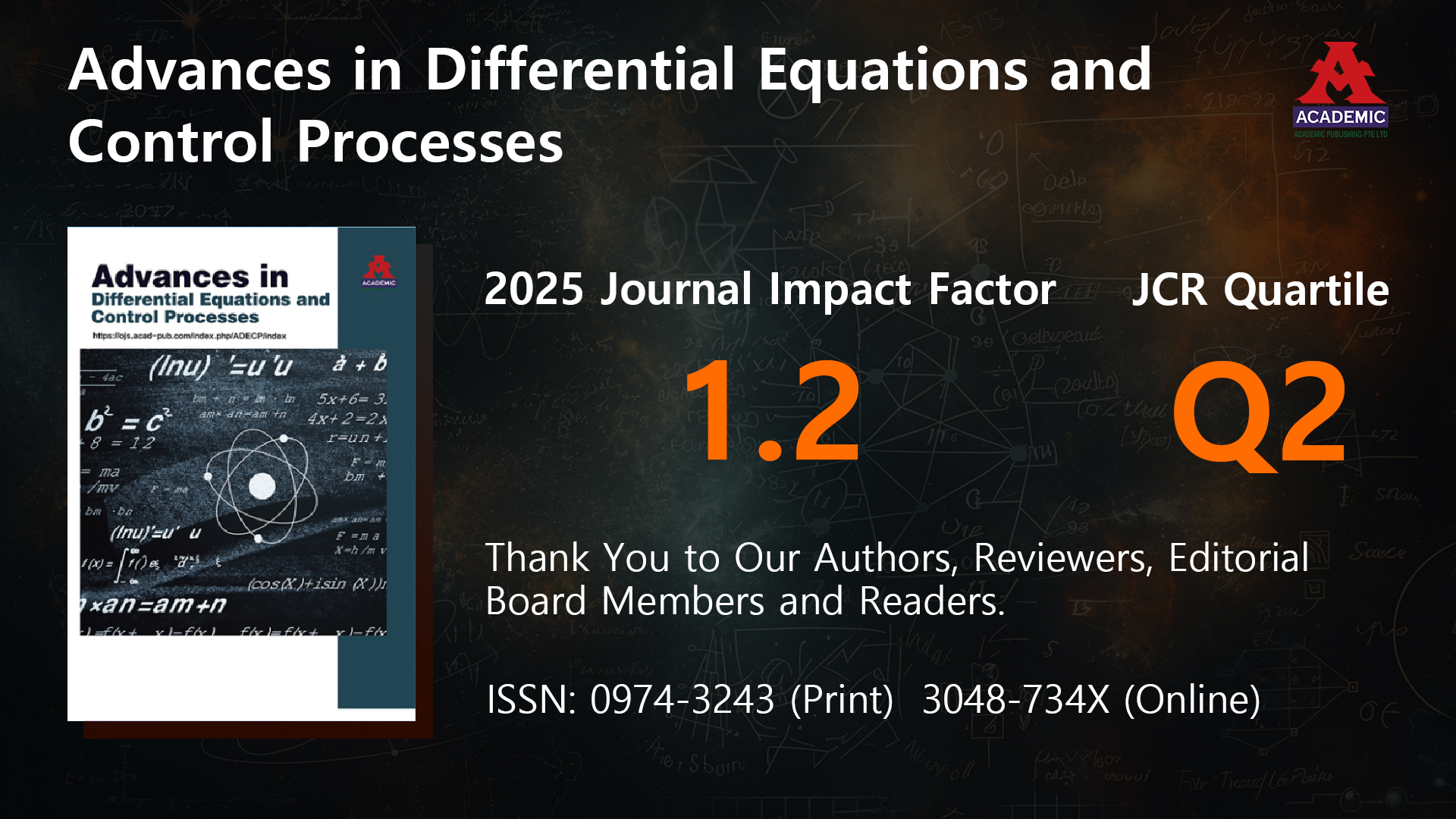
Description

The Advances in Differential Equations and Control Processes is an esteemed international journal indexed in the Emerging Sources Citation Index (ESCI). It publishes original research articles related to recent developments in both theory and applications of ordinary and partial differential equations, integral equations, and control theory.

The journal particularly encourages submissions related to process/system research in fields such as chemistry, biology, materials science, energy, environmental science, food science, pharmaceuticals, manufacturing, automation control, catalysis, separation processes, particle engineering, and related engineering disciplines. Emphasis is placed on articles that have the potential to introduce new techniques supported by practical applications. Additionally, the journal welcomes survey articles that explore future research directions.


From December 1, 2024, Academic Publishing will acquire Advances in Differential Equations and Control Processes from Pushpa Publishing House, and will publish this journal from Vol. 32 (2025) onwards. Moreover, from 14 November 2024, new submissions should be made to the new Open Journal Systems

Latest Articles

  • Open Access

    Articles

    Article ID: 3815

    Unraveling structural equation modeling: Key assumptions, model fit, and trends

    by Jack Ng Kok Wah

    Advances in Differential Equations and Control Processes, Vol.33, No.1, 2026;

    Structural equation modeling (SEM) serves as a cornerstone analytical tool across disciplines, enabling robust tests of complex relationships. Yet, core assumptions, model fit, measurement invariance, missing data handling, and causal inference validity spark ongoing debates. Despite methodological progress, challenges linger in parameter estimate reliability, sensitivity to model changes, and integration with alternative approaches. This study critically synthesizes recent empirical and theoretical insights to scrutinize these assumptions. A review of contemporary studies spotlights trends like refined fit evaluation, SEM-fsQCA synergies, and machine learning incorporation. Findings expose inconsistencies in missing data treatment and model respecification, varying by discipline. Quantitative focus sharpens model fit indices, while qualitative views stress theoretical justification hurdles. Cross-disciplinary analysis (psychology, finance, education, healthcare, marketing) reveals uneven assumption adherence, questioning generalizability, especially for cross-cultural data and ordinal variables. Hybrid integrations, such as SEM with system dynamics or network analysis, boost predictive accuracy and curb violations. SEM endures as powerful but demands nuanced assumption testing for theoretical and empirical soundness. Implications urge interdisciplinary collaboration on validation. Limitations encompass publication bias and the omission of unpublished advances. Future work should probe alternative fit techniques, violation impacts, and AI-driven diagnostics, fostering reliable, replicable SEM applications.

    show more
  • Open Access

    Articles

    Article ID: 3725

    Unified framework of four Caputo fractional differences for initial and final value problems in discrete fractional calculus with variable bounds

    by Xiaomin Li, Huaigu Tian, Peijun Zhang, Jun Ma

    Advances in Differential Equations and Control Processes, Vol.33, No.1, 2026;

    Fractional calculus has emerged as a powerful tool for characterizing non-classical dynamic phenomena, yet its discretization remains fragmented, with existing studies primarily focusing on single combinations of variable bounds and difference directions. To address this gap, this paper proposes a unified theoretical framework for discrete fractional calculus by systematically introducing four novel Caputo fractional difference definitions, which integrate variable upper/lower-limit sums with forward/backward difference operations. First, we rigorously derive the fundamental properties of these four definitions, including the commutativity of fractional sums and differences, and their consistency with integer-order difference operations. Second, we construct fractional difference equations for each definition, establish their equivalence to Volterra sum equations, and provide explicit solutions and strict proofs for their corresponding initial and final value problems. To validate the theoretical results, we design four targeted computational cases and numerical simulations, confirm the consistency between theoretical solutions and numerical results, and intuitively demonstrate the long-memory effect of fractional-order discrete systems. Furthermore, we present a concise comparison of the four definitions, clarifying their suitability for discrete systems with distinct boundary conditions and dynamic characteristics. This work not only completes the theoretical system of discrete fractional calculus with variable bounds but also provides standardized and targeted mathematical tools for modeling complex discrete dynamic processes, laying a solid foundation for the practical application of discrete fractional calculus in fields such as engineering control, infectious disease modeling, and economic dynamics.

    show more
  • Open Access

    Articles

    Article ID: 3774

    Data-driven hierarchical decision support for civil aviation maintenance safety risk: A fusion of Bayesian network and system dynamics

    by Jirong Duan, Ming Cheng

    Advances in Differential Equations and Control Processes, Vol.33, No.1, 2026;

    To enhance the scientificity and precision of risk analysis and management decision-making in aircraft maintenance operations, this study proposes a risk analysis-decision model tailored to maintenance events. Based on actual civil aviation maintenance scenarios, the model employs real data to conduct data-driven analysis and precisely calculates the occurrence probabilities of various risk factors by constructing a Bayesian risk probability network. Meanwhile, it selects three categories of key risk factors: personnel (A), management (B), and organization (C), to build a system dynamics scenario, thereby simulating the long-term implementation effects of different management strategies. The research findings indicate that the existing maintenance management system demonstrates a certain level of risk buffering efficacy under normal operating conditions, effectively preventing risks from evolving into higher severity levels. The combinations of key risk factors at different severity levels exhibit a hierarchical characteristic, specifically manifesting as three tiers dominated by organization and safety barriers, personnel capabilities and behaviors, and daily operations and slow-variable risks, respectively. It is proposed that maintenance safety risk governance should adopt a graded and differentiated management strategy. At the decision-making level, the model is capable of simulating the long-term impacts of different management strategies. The study reveals that increasing management investment can significantly reduce process risks, whereas systemic risks and frontline operational errors require sustained, long-term resource allocation for improvement.

    show more
  • Open Access

    Articles

    Article ID: 3861

    A multi-stage decision-making model for urban fire emergency with multi-granularity uncertain linguistic information and prospect theory

    by Xuemei Zhou, Nady Slam

    Advances in Differential Equations and Control Processes, Vol.33, No.1, 2026;

    Existing fire emergency decision-making models often struggle with accurately handling multi-granularity uncertain linguistic information, loss aversion, and a lack of adaptability to dynamic fire evolution. To address these gaps, this study adopts two-tuple linguistic representation (2TLR) for quantifying multi-granularity linguistic information and combines the Analytic Hierarchy Process (AHP) with the entropy weight method (EWM) to determine the ability weights of the experts. Furthermore, a six-dimensional dynamic reference point is generated via the random forest algorithm, and the integration of prospect theory (PT) with a sequential decision-making framework (SDF) is implemented for the dynamic optimization of response plans. Validation through real-world cases demonstrates that the proposed Multi-stage Prospect Selection (M-PS) model outperforms both the TOPSIS method and the single PT model, compared with these two methods, the proposed M-PS model can effectively prioritize the avoidance of high-risk scenarios, accurately reflect decision-makers’ loss aversion tendency, and realize dynamic decision-making through updating the decision plan sequentially, thereby providing reliable support for urban fire emergency management. At the same time, in this study we conduct a comparative analysis of core metrics between existing methods and the proposed M-PS model. The evaluation across five dimensions demonstrates that the proposed M-PS model delivers superior performance.

    show more
  • Open Access

    Article

    Article ID: 3719

    Stability of totally-positive switched linear systems with mode-dependent average dwell time switching

    by Yanping Guo, Yijing Li, Lei Tai, Qiang Yu

    Advances in Differential Equations and Control Processes, Vol.33, No.1, 2026;

    Totally-positive switched linear systems (TSLSs), as one of the special switched system classes, have both the complex dynamic behavior of switched systems and their special dynamic properties of totally positive dynamical systems. Recently, TSLSs have attracted scientists’ extensive attention, due to their wide applications, such as economics, biology, communication, and electronic information engineering. The research focuses on the stability issue of TSLSs. Several new exponential stability criteria of TSLSs in both continuous-time and discrete-time cases are obtained by combining the strategy of mode-dependent average dwell time (MDADT) and the multiple linear co-positive Lyapunov function approach. Those stability criteria obtained are presented in the form of linear constraints, making them easy to verify and apply through tools such as linear programming (LP). Since the MDADT framework only limits the average dwell time (ADT) of each subsystem and does not impose restrictions on the switching order or subsystem activation frequency, the conclusion of this paper is robust for switching sequences. The corresponding ADT stability criteria have also been inferred. Furthermore, it is pointed out that the stability issue under arbitrary switching can be solved by the common linear co-positive Lyapunov function (CLCLF) method. Finally, the efficiency of the results is verified by two numerical examples. One of them is from the epidemiological models, which provides a practically motivated TSLSs to make the validation more convincing.

    show more
  • Open Access

    Article

    Article ID: 3821

    Adaptive Enriched Rational Spectral Methods with sinh transformations and asymptotic correctors for variable-coefficient singular perturbation problems

    by Lufeng Yang

    Advances in Differential Equations and Control Processes, Vol.33, No.1, 2026;

    This paper introduces and analyzes novel Enriched Rational Spectral Methods for efficiently solving singular perturbation problems exhibiting sharp boundary layers. While spectral methods are known for their ‘spectral accuracy’ in solving smooth problems, their performance deteriorates for stiff differential equations because they fail to resolve rapid transitions in the solution. To overcome this limitation, we propose a rational spectral collocation framework enriched with asymptotic corrector functions. These correctors are derived directly from a boundary layer analysis of the variable-coefficient operator itself, enabling them to accurately capture the solution's singular behavior. Two specific schemes are proposed: the Enriched Spectral Method (ESM) and the Enriched Rational Spectral Method combined with a sinh transformation (ERSM-sinh). In ERSM-sinh, the corrector functions are integrated with a sinh transformation whose parameters—layer location and width—are determined from asymptotic estimates. The correction parameters are obtained implicitly by solving the discrete algebraic system arising from the original problem. Extensive numerical experiments on convection-diffusion and reaction-diffusion problems with variable coefficients demonstrate the superior performance of our methods. Results show that ERSM-sinh maintains robust spectral accuracy, significantly outperforms existing approaches such as RSC-SSM and RSCAT for variable-coefficient problems, and achieves high precision with minimal computational cost—even for very small perturbation parameters (e.g., ε = 1010). This work provides a high-resolution, efficient, and generalizable framework for singularly perturbed boundary value problems.

    show more
  • Open Access

    Article

    Article ID: 3811

    A unified multi-physics model for co-design: Enhancing efficiency and enabling compact thermal management in vanadium redox flow battery stacks

    by Jacer Hamrouni, Leila Abdelgader, Chafaa Hamrouni, Abdennaceur Kachouri Kachouri, Mounir Baccar

    Advances in Differential Equations and Control Processes, Vol.33, No.1, 2026;

    This work develops a control-oriented, lumped-parameter model for vanadium redox flow battery (VRFB) stacks. The framework integrates mass, charge, energy, and momentum transport with electrochemical kinetics via a coupled system of ordinary differential equations (ODEs) and algebraic constraints, bridging system dynamics and electrochemical engineering. A key methodological advancement is the application of a hydraulic-electrical network analogy, utilizing Kirchhoff's laws to simulate electrolyte flow and shunt current pathways across a 20-cell stack, thereby transforming complex three-dimensional physics into a tractable, control-oriented formulation. The model directly links physical fidelity to actionable performance insights. Simulations identify that non-uniform flow distribution induces significant local state-of-charge gradients, exacerbating shunt currents. This parasitic effect can reduce effective charging current by up to 2.1% and increase discharge overpotentials. Through analysis of these coupled interactions, the study demonstrates that optimized flow management and thermal control can mitigate losses. Specifically, regulating stack temperature below 40 °C via a novel targeted tank-cooling strategy rather than full-system cooling prevents vanadium precipitation while improving round-trip efficiency, achieving a 27.2% reduction in cooling energy consumption. Furthermore, the model reveals that tank-based heat rejection dominates convective heat transfer (85.8%), enabling a transformative redesign where thermal management is consolidated at the tanks. This permits a more compact stack enclosure and reduces balance-of-plant complexity. The work establishes a validated mathematical framework that advances the fundamental understanding of coupled transport in VRFBs and provides a direct pathway to designing more efficient, compact, and cost-effective systems.

    show more
View All Issues

Announcements

Acknowledgment to the Reviewers of Advances in Differential Equations and Control Processes in 2025

2026-02-06

The Editors and Publisher of Advances in Differential Equations and Control Processes extend their sincere appreciation to all reviewers who contributed their time, expertise, and scholarly judgment to the peer-review process in 2025.

Peer review is a cornerstone of high-quality academic publishing. The careful, fair, and constructive evaluations provided by our reviewers play a critical role in maintaining the scientific rigor, integrity, and credibility of the journal. Their contributions not only support editorial decision-making but also assist authors in improving the clarity, validity, and impact of their research.

We deeply appreciate the commitment demonstrated by reviewers, whose voluntary service represents an essential contribution to the global academic community. The journal remains firmly committed to recognizing the value of peer review and to continuously enhancing the transparency, efficiency, and quality of its editorial and review processes.

The following individuals served as reviewers for the journal during 2025.

Names are listed alphabetically.

Please refer to the attachment in the announcement.

[ADECP] Acknowledgment to the Reviewers in 2025.pdf

Read more about Acknowledgment to the Reviewers of Advances in Differential Equations and Control Processes in 2025