

 Open Access
Mansoura University, Egypt
All the publications will be archived by the PKP Preservation Network for long-term electronic preservation.
Authors are encouraged to self-archive the final version of their published articles into institutional repositories (such as those listed in the Directory of Open Access Repositories).
Authors are also encouraged to use the final PDF version published on the website of Academic Publishing.
J-Gate
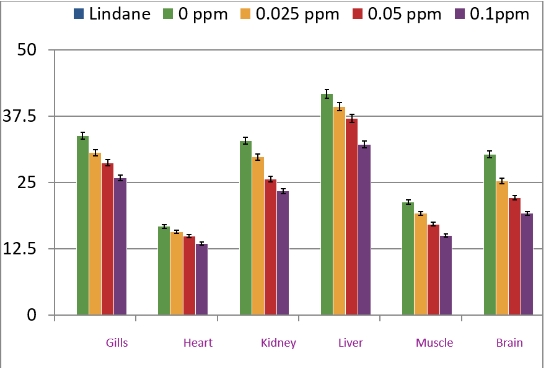
Na + -K + -ATPase is a membrane bound enzyme responsible for the transport of ions through the membrane and immediate release of energy. This enzyme is known to be an early target for oxygen radical induced damage to intact cell. Exposure of C. punctatus to subacute concentrations of lindane for 96 h caused significant reduction in the activities of Na + -K + -ATPase in all the tissues of the fish tested; brain being maximally affected and the heart being least affected organ at the highest concentration of lindane (0.1 mg/L). The effect of pesticide was concentration dependent. The percent decrease in the activity of Na + -K + -ATPase in brain, gills, heart, kidney, liver and muscle was found to be 36.7, 23.4, 19.2, 29, 22.9 and 29.7, respectively. The order of level of enzyme activity recorded was as following: liver > gills > kidney > brain > muscle > heart in the control.